Every Knicks fan knows that we may or may not be receiving a first rounder from the Mavs, but it’s also pretty confusing trying to figure out exactly what’s going on. The ESPN Deep State has these trade stipulations locked up tighter than Fort Knox, but your’s truly has almost all the answers. I broke this out into two sections: 1) What’s actually going on with the pick, and 2) is this even a big deal or not.
(Side note: if anyone can tell me how to change the colors of the tables below please tell me. I reloaded the page and they turned yellow but I can’t fix it).
NBA trades are way more convoluted than, for example, the NFL. Most NFL trades involving first rounders are generally pretty straight up, with exceptions being like that Carson Wentz (bum, btw) trade, where he had to play a certain amount of games for that pick to convey. But even in that example, the pick either conveys or it doesn’t. In the NBA however, most traded picks have some level of protections that can usually fall in one of these general categories:
- The pick either conveys or not. Example: a first round pick is top 10 protected, so if the team finishes 11-30, they lose the pick, and if they finish 1-10, they keep it. Nothing more, nothing less. This is less common than you’d think.
- A pick is protected, but if it doesn’t convey that year, it gets pushed to the following year with lessening protections until it becomes unprotected. Example: a pick is top 10 protected in 2023, top 7 protected in 2024, top 5 protected in 2025, and unprotected in 2026. Generally, protected picks will either be like this example or the following ones since it protects teams from decade-ruining catastrophe.
- A pick is protected, but if it doesn’t convey that year, it gets pushed to the following year with lessening protections until it becomes any number of second rounders. The example would be just like the previous, but it obviously becomes second rounders instead of unprotected.
- The final category(s) is just the two previous ones, but without lessening protections. So the example would be instead of the pick being protected top 10 in 2023, top 7 in 2024, and so on, its just top 10 protected until it becomes unprotected/second rounders. I think you follow, but as my reader-base knows, I love to overexplain. (Hint: this is the Knicks-Mavs pick).
So here is what’s happening to the Knicks pick:
- If the Mavs get pick 1-10, it stays with them this year. The pick has a ~20.2% of falling outside of the top 10, so it’s unlikely we get it but 1 in 5 odds aren’t terrible.
- If the Mavs end up keeping the pick, then it will have the same top 10 protections for the next two seasons. I’m pretty sour on the Mavs future, but it seems highly unlikely a team with Luka Doncic finishes bottom 10 for 3 consecutive years.
- If it still doesn’t convey at that point, it will become second rounders. One would think that “how many second rounders?” would be an easy question to answer but it’s just not. I think it’s 2 since that’s typical, but it’s hard to find that answer anywhere. Regardless, this is the worst but unlikely scenario.
- In summary, we probably won’t get it this year, but probably will in the next two years. Interestingly enough, not getting it this year could be a blessing in disguise. If we don’t get it, then we still have the pick to trade in the future. Generally, teams seem to value the ambiguous value of future picks more than picks today. It shouldn’t be the case, but you have to admit “future first round pick” sounds better than “the 13th pick in this upcoming draft.” We already have a ton of young guys who need minutes (looking at Obi, but also guys like Mile McBride), so I’m not not sure if getting some mid round rookie this year is better than having another trade chip to pull off another Josh Hart-esque trade.
Speaking of that last point, how valuable is this pick? Is this actually a big deal to lose this pick? I’m glad I asked because I’m about to answer that.
First and foremost, I’m not going to pretend that not having a first rounder is a great thing. Typically, you’d rather have it than not have it. The Knick’s have been great at drafting in prior years but we do seem to specialize at smart late round picks (Grimes, Quickley, Mitch (2nd round)). So am I happy that we probably won’t have it? No. But do I think it’s a huge deal? Also, no.
Looking at past drafts, individual picks past the top 3 are just not as valuable as people think. The best thing they do is provide depth with cost controlled contracts, but these guys are generally replacement level players. There’s a really good article on this, but I’m sitting on my roof in the heat with crazy sun glare so can’t figure out how to add a link. Honestly, everyone reading this knows me personally so just text me and I’ll send you the article, but I’ll summarize it here:
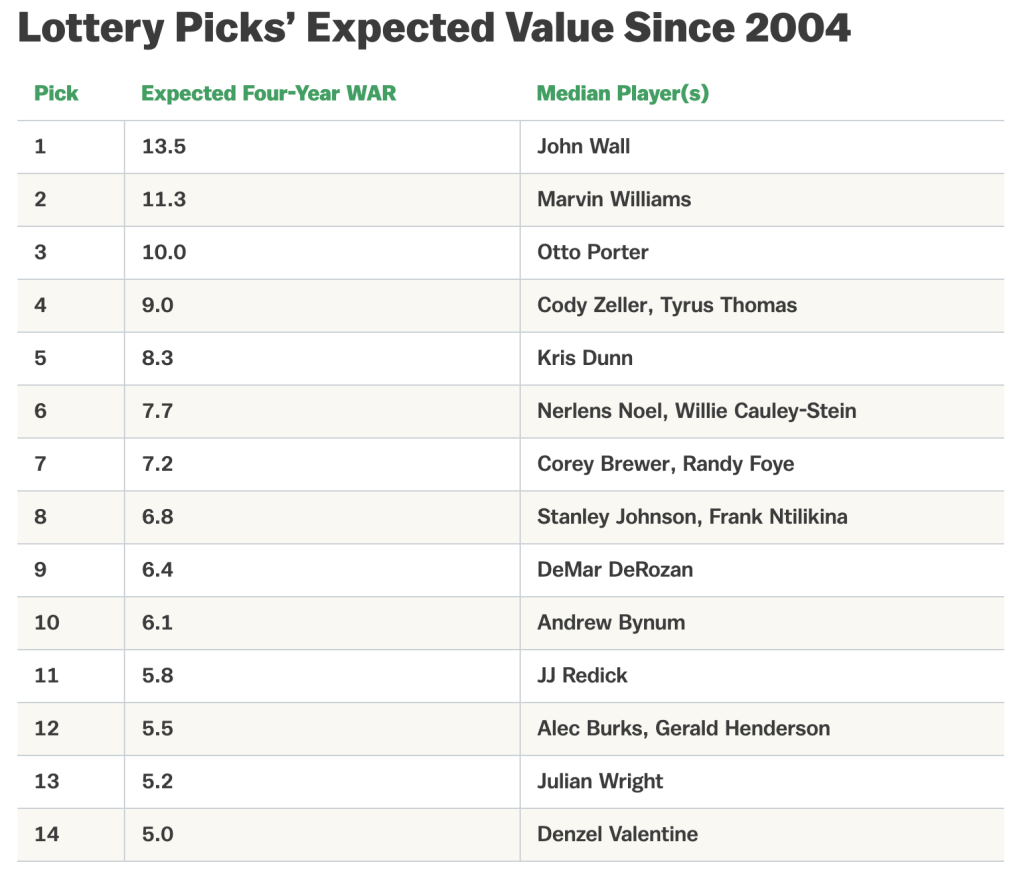
So this table is giving the expected four year WAR for each lottery pick and the median player. Couple points: 4 years is the length of a rookie deal, WAR is a good all encompassing stat (not 100% accurate but it gets the job done when you’re trying to get a general idea of what sort of players fall here), and the median player gives you an idea of what to expect from that pick. My immediate take from this is that these guys aren’t very good! Maybe they don’t suck but you can get a Julian Wright level guy for cheap in FA. In fact, the 12 pick usually nets you an Alec Burke level playerhe Knicks literally picked him him up for peanuts and a washing machine 2 years ago. He’s actually a good example because I liked him, but as a solid veteran FA pickup, not as a lottery pick. Keep in mind guys like Redick and especially DeRozan are good players, but WAR has them below Franky Smokes so it’s not very promising. Again, it isn’t a perfect stat, but you get the idea that the sort of players between 5-7 WAR are the Stanley Johnsons and Gerald Hendersons of the world. Obviously you can pick out good players who were taken at these picks, but your average guy just isn’t someone to write home about. After John Wall at 1, the only guys you’d be excited for are DeRozan, Redick, and maybe even Andrew Bynum (complicated).
Going even deeper, most of the guys taken in the top 10 don’t even stay with their team. Below I have the 6-14 range (non top 5 lottery picky and +/- 4 on the 10th pick; the sort of level guys we’d be looking at) from the 2016-2019 drafts. By the way, I stopped at 2019 since guys drafted after that are obviously still on their rookie contracts so likely won’t be moving until after it expires. Plus, everyone including me still has hope for newly drafted guys.
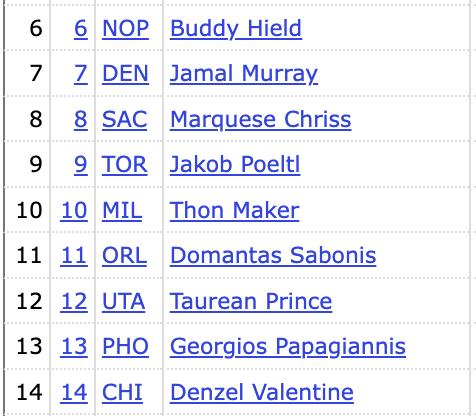


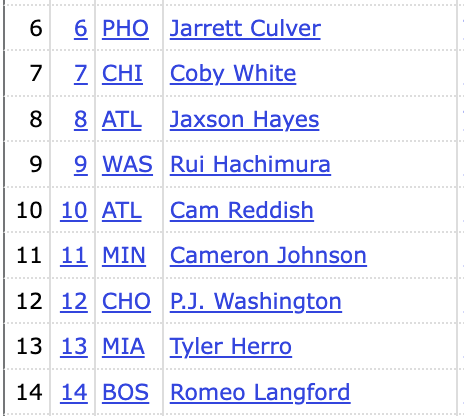
Obviously guys like Jamal Murray standout, but most of these dudes just arn’t that great. Some of the best guys (Lauri, Bridges, Hield, and Sabonis) aren’t even on the team that drafted them. It’s already unlikely that the guy is any good, and it’s even more unlikely that he’ll be on your team 4 years later. SO anytime you feel upset that we might not get our 11-14 pick this year, ask yourself why you’re losing sleep over the future Georgious Papagiannis (WHO??).
So I don’t want to give off the idea that I don’t value first round picks. Any of my friends will tell you that I’m a stickler for trading our cache of picks for guys, but that’s sort of my point. I heavily value first round picks when they’re grouped together as a trade package, but I just don’t value an individual late lottery pick that much. I said this before, but in some way I’m glad that it’s not conveying now since we continue to get a trade chip instead of a mediocre depth player. These front offices value picks so much since they always think they’re getting Jamal Murray or Tyler Herro, but just looking at the evidence they usually get Taurean Prince or Kevin Knox.
So to answer the original question: no, it’s not a big deal that we’re losing this pick. It’ll suck sitting out on draft night and I’m sure fake fan Stephen A will have a lot to say about it but believe me, not having a pick won’t move the needle. Am I coping? Maybe, but it’s not like Thibs would even play him either.
 KnicksTape
Leave a comment